



Why Airlines Are Cracking Down on Lithium Battery Devices
If you've flown recently, you may have noticed cabin crew paying closer attention to power banks, or airports displaying new signs about lithium battery limits. This isn't incidental — it's the result of a deliberate, coordinated tightening of aviation safety rules driven by a sharp rise in onboard battery fire incidents. This guide explains what's happening, what the rules now say, and how to travel with all your tech without causing delays at the gate.
Why This Is Happening Now
The crackdown on lithium battery devices isn't a sudden policy decision — it's the culmination of years of rising incident data.The FAA recorded 97 fire incidents linked to lithium batteries on planes in 2025, up from 89 in 2024 — and that follows a 42% rise in incidents concerning lithium batteries between 2018 and 2023.
The specific danger is a phenomenon called thermal runaway.The FAA states: "All lithium ion batteries are capable of overheating and undergoing a process called thermal runaway. Thermal runaway can occur without warning as a result of various factors, including if the battery is damaged, overheated, exposed to water, overcharged, or improperly packed."
The reason this matters so much in aviation specifically comes down to location.If a device were to malfunction and catch fire in the cargo hold, there would be little to no ability to detect or extinguish the fire in time. In the cabin, crew can respond immediately with fire suppression equipment. This is the fundamental logic behind every lithium battery rule you encounter at an airport.
The Rules Right Now: What UK Travellers Must Know
Aviation rules vary by airline, but the baseline established by the UK CAA, ICAO, and IATA sets the floor that every carrier must meet. Here's a clear summary of where things stand for UK departures:
| Device | Checked Hold Luggage | Cabin Hand Luggage | In-Flight Use |
|---|---|---|---|
| Laptops & tablets | Discouraged / airline-dependent | ✓ Always carry on | ✓ Permitted |
| Smartphones | ✓ Permitted (device must be off) | ✓ Preferred | ✓ Permitted (flight mode) |
| Power banks (under 100Wh / ~27,000mAh) | ✕ Banned — all airlines | ✓ Max 2 per person (from Mar 2026) | Check your airline |
| Power banks (100–160Wh) | ✕ Banned | Max 2 with airline approval | Check your airline |
| Power banks (over 160Wh) | ✕ Banned | ✕ Banned on passenger aircraft | ✕ Banned |
| Smart luggage (built-in USB) | ✓ Port only (no power bank inside) | ✓ Permitted | USB port with compliant power bank in accessible pocket |
| E-cigarettes / vapes | ✕ Banned | ✓ Carry-on only | ✕ No use in-flight |
UK Airline Policies at a Glance
| Airline | Power Bank Limit | Storage Rule | In-Flight Use |
|---|---|---|---|
| Ryanair | Up to 100Wh without approval (up to 20 power banks permitted) | Carry-on baggage only. Never in checked luggage. | Permitted |
| easyJet | Up to 160Wh. Maximum 2 power banks per passenger. | Carry-on baggage only. Recommended to keep on your person and individually protected. | Permitted |
| British Airways | Up to 100Wh. Batteries between 100–160Wh require airline approval. | Must be carried in cabin baggage and protected against short circuits. | Permitted |
| Jet2 | Up to 100Wh without approval. Up to 2 batteries between 100–160Wh with approval. | Carry-on baggage only. Power banks prohibited in checked luggage. | Permitted |
| Lufthansa | Up to 100Wh without approval. Up to 160Wh with airline approval. | Must remain in carry-on baggage and be easily accessible. | Permitted, but battery charging restrictions may apply on some routes. |
| TUI | Up to 100Wh without approval. 100–160Wh requires airline approval. | Carry-on baggage only. Never permitted in hold luggage. | Permitted |
What This Means for How You Pack
The practical consequence of all these rules is the same for every traveller: every device with a lithium battery needs to be in your cabin luggage, accessible at all times, and ideally visible rather than buried at the bottom of a bag. That shifts the requirements of a well-designed cabin bag significantly.
A cabin bag that worked perfectly five years ago — one big compartment, pack it full, zip it shut — creates real problems in the new regulatory environment. Security screening requires your laptop out quickly. Airline staff may ask to inspect your power bank. Cabin crew on some carriers will need to see that your power bank isn't stored in the overhead bin. All of this is dramatically easier when your bag is designed with dedicated, accessible compartments for tech.

Dedicated Front Laptop Pocket
A separate front-access laptop compartment means you can pull your laptop at security in seconds without opening the main bag. Padded protection keeps the device safe; quick access keeps the queue moving.
Accessible Power Bank Pocket
Airlines increasingly require power banks to be reachable — not buried in a packed main compartment. An interior power bank pocket keeps yours separate, identifiable, and ready for inspection or retrieval by cabin crew if required.
USB Port for Compliant Charging
A built-in USB port routed from an internal power bank pocket lets you charge devices on the go — with your power bank in a compliant, accessible location. The port is simply a cable; the power bank is what you supply, and it stays where regulations say it should be.
TSA Lock for Security Screening
With security checks becoming more thorough for tech-heavy travellers, an integrated TSA-approved lock means security can inspect and re-lock your bag without damaging it — crucial if you're carrying multiple valuable devices.
Aerolite Cabin Bags Built for the New Rules
All three Aerolite cabin bags below are designed at exactly 55x40x20cm — the Ryanair Priority maximum and widely accepted across UK and EU airlines — with dedicated tech-accessible front compartments that make compliance with current lithium battery rules straightforward rather than stressful.

Aerolite Waterproof Cabin Trolley Bag — 55x40x20cm
A waterproof 44L carry-on built for tech-heavy travellers. The dedicated front compartment holds laptops up to 17 inches, keeping your device separate and instantly accessible for security screening. TSA lock, 2 wheels, and full waterproof construction — ideal for travellers who want maximum protection for electronics on board.
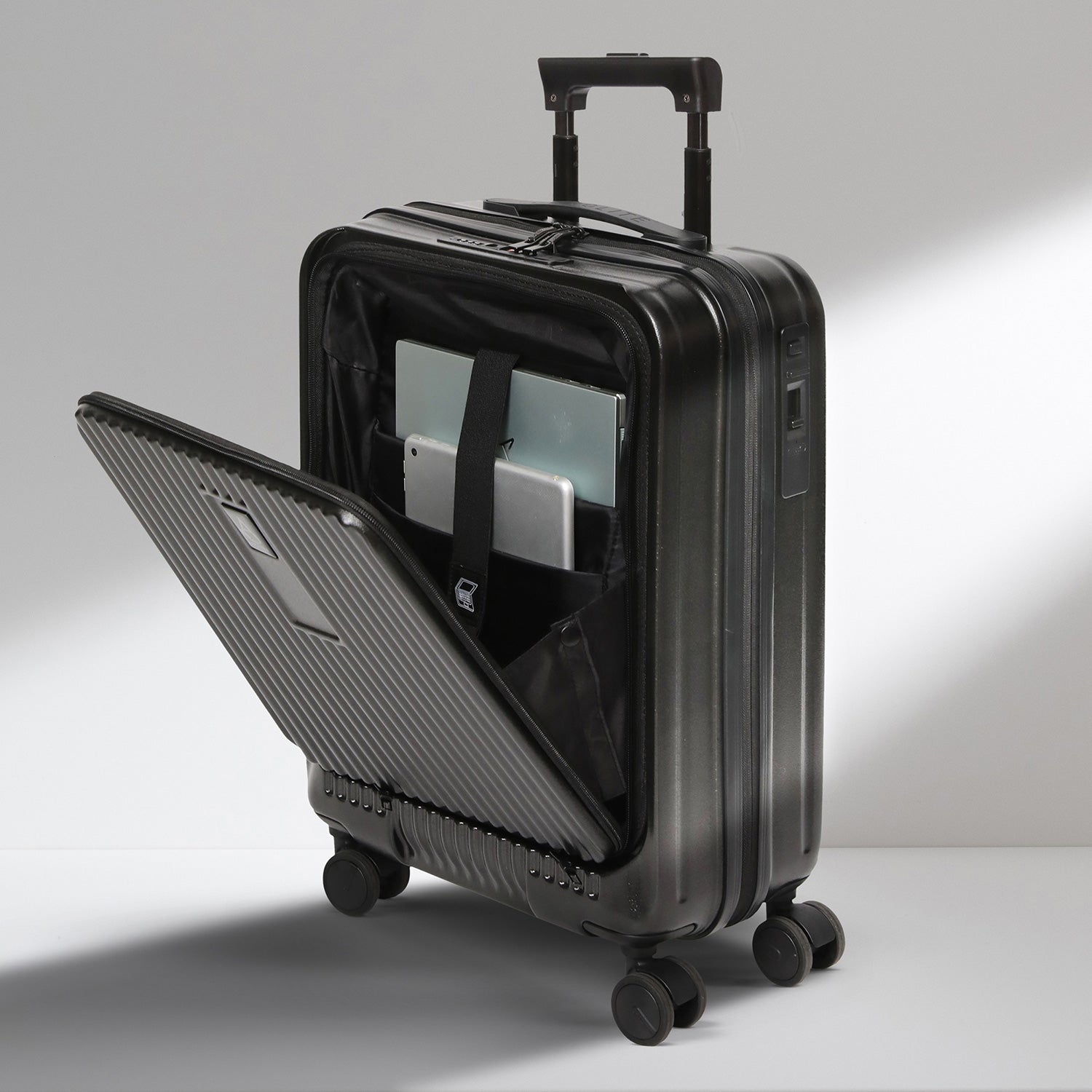
Aerolite M-Lite Smart 21" Cabin Suitcase — 55x40x20cm
The full smart travel setup in one cabin bag. A quick-access front compartment holds laptops and tablets securely with a padded sleeve, a built-in USB port lets you charge on the go (power bank not included — stays in the dedicated interior power bank pocket for full airline compliance), a phone holder keeps your device visible and accessible, and a dual drink holder handles the rest. Silent Japanese Hinomoto wheels with brake button, durable PP shell, and TSA lock. Expands to 55x40x23cm for Wizz Air and Lufthansa.

Aerolite Expandable Soft Shell Cabin Suitcase — 55x40x20cm to 55x40x23cm
A lightweight, expandable cabin suitcase designed to maximise your packing allowance across Europe's leading airlines. Sized to fit Ryanair Priority at 55x40x20cm and expanding to 55x40x23cm for Wizz Air Priority, Lufthansa, and many other carriers, it offers up to 48 litres of packing space while weighing just 2.45kg.
The Pre-Flight pack-list: Travel Compliantly Every Time
Use this pack-list before every flight to ensure your tech is packed and positioned correctly.
A Note on Smart Luggage and USB Ports
Smart suitcases with built-in USB charging ports have become increasingly popular — and they're entirely permitted under current aviation rules, with one important nuance. The USB port in the suitcase is simply a cable and connector. The power bank that actually powers it must be a removable unit that you supply separately, carried in an easily accessible interior pocket in compliance with your airline's power bank rules.
This is exactly how Aerolite's M-Lite Smart cabin suitcase is designed. The USB port is built in, but the power bank sits in a dedicated interior pocket — visible, accessible, compliant, and easy to present to cabin crew on the increasingly common occasions when they ask passengers to account for their lithium battery devices.
Cabin bags built for modern travel.
Dedicated tech pockets, TSA locks, and airline-precise dimensions. Free delivery across the mainland UK.
Frequently Asked Questions
Common questions about flying with lithium battery devices.
Can I take a power bank on a Ryanair flight?
Yes — but only in your cabin hand luggage, never in checked baggage. Ryanair follows UK CAA and ICAO guidelines: power banks up to 100Wh are permitted in carry-on baggage and should be kept in your small cabin bag under the seat in front of you or on your person. They must not be stored in the overhead bin. Always confirm the current policy on Ryanair's website before flying.
Why are airlines banning lithium batteries in checked luggage?
Lithium-ion batteries can overheat and trigger thermal runaway — an uncontrollable reaction that causes fire, explosion, and toxic gas release. In the cargo hold, a fire can spread undetected before crew are even aware of it. In the cabin, crew can respond immediately with fire suppression equipment. This is why aviation authorities globally require lithium batteries to travel in the passenger cabin, not the hold.
How many power banks can I take on a flight?
Under ICAO rules effective from 27 March 2026, passengers are limited to two power banks per person. Each must be rated under 100Wh (roughly 27,000mAh). Devices between 100Wh and 160Wh may be permitted with airline pre-approval. Anything above 160Wh is banned on passenger aircraft. Always check your specific airline's current policy before travelling.
Do I need to declare my laptop at airport security?
At most UK and European airports you will be asked to remove your laptop from your bag and place it in a separate tray for X-ray screening. A cabin bag with a dedicated quick-access front laptop compartment makes this significantly faster — you can remove and replace the device in seconds without unpacking your main luggage.
Can my suitcase have a USB charging port?
Yes — suitcases with built-in USB ports are permitted in cabin luggage. The USB port is simply a cable; the power bank that powers it must be your own, comply with your airline's rules (under 100Wh, in cabin baggage only, accessible at all times). Aerolite's M-Lite Smart cabin suitcase includes a USB port and a dedicated interior power bank pocket so your bank remains accessible and compliant throughout the flight.
What happened to the Air Busan flight that prompted the crackdown?
In January 2025, Air Busan Flight 391 was destroyed by a fire traced to a portable power bank stored in a rear overhead luggage bin at Gimhae International Airport in South Korea. All 176 people aboard evacuated safely, but the aircraft was gutted. The incident prompted aviation authorities worldwide, including the UK's Civil Aviation Authority, to accelerate new restrictions on power bank storage and use aboard aircraft.
What size laptop fits in the Aerolite waterproof cabin trolley bag?
Aerolite's waterproof 55x40x20cm cabin trolley bag features a dedicated front laptop sleeve that fits devices up to 17 inches, covering the full range of standard laptops including 13", 14", 15.6", and 17" models. The sleeve sits in a front compartment separate from the main packing area, so your laptop is accessible without unpacking anything else.