



TSA Locks Explained: What They Are and Why You Need One
You've seen the letters "TSA" on a suitcase and probably assumed it meant something to do with security — and you'd be right. But a TSA lock isn't just a marketing badge. It's a specific type of lock that solves a real problem that every international traveller faces: how to lock your bag securely, without airport security having to break it open to inspect it. This guide explains everything you need to know, clearly and without the jargon.
What Is a TSA Lock?
TSA stands for the Transportation Security Administration — the US government agency responsible for aviation security. After 2001, the TSA began requiring access to checked luggage for security screening at US airports. The problem: if your bag was locked with a standard padlock and security needed to inspect it, they had two options — wait for you to come and unlock it (impractical), or cut the lock off. Most people found their locks cut and their bags travelling the rest of the journey unsecured.
The solution was the TSA lock system. The TSA worked with lock manufacturers to develop a set of universal master keys — around 12 in total — that can open any lock carrying the TSA approval. Security uses their master key to open your bag, inspect it, re-lock it, and return it to the conveyor. Your lock stays intact. Your bag stays secured. You arrive to find everything exactly as you left it.
TSA-approved locks carry a small red diamond logo or the letters "TSA" on the lock body. That symbol tells security worldwide that the lock is compatible with their master keys.
How a TSA Lock Works: Step by Step
You lock your suitcase with your combination
Set your personal 3-digit code on the combination lock. The lock secures the zipper pulls or frame of your suitcase, preventing anyone from opening the main compartment. Only someone who knows your code — or has the TSA master key — can open it.
Your bag goes through security screening
Your checked bag passes through X-ray scanners at the airport. If security identifies something inside that requires a closer look, a manual inspection is triggered. Without a TSA lock, they would need to cut the lock. With a TSA lock, they use the master key.
Security opens the bag using their master key
Airport security uses one of the TSA master keys to unlock your bag — without needing your combination. They inspect the contents, satisfy themselves everything is in order, and re-lock the bag using the same master key. The lock is re-secured and your bag continues on its journey.
A notice of inspection may be left inside
If your bag was opened, security often places a small "Notice of Baggage Inspection" slip inside. This simply confirms the bag was inspected and re-secured. Your lock is undamaged. Your belongings are intact. Your combination still works exactly as before.
You collect your bag — locked, secure, undamaged
At the baggage carousel, your bag arrives with its TSA lock still secured. You enter your personal combination to open it. Everything is exactly as you left it — inspected, re-locked, and fully intact.
What Happens Without a TSA Lock?
If your checked bag has a non-TSA lock — a standard combination lock, a padlock, or any lock without the red diamond approval — and security needs to inspect it, they cannot use the master key system. They have no way to open it without your combination.
The result: the lock is cut off. Your bag then travels the remainder of the journey with no lock at all — unsecured at every handling point, on every connecting flight, and through every subsequent carousel. This is not a hypothetical scenario. It happens on every flight where a non-TSA lock is present and inspection is triggered.
Three Types of TSA Locks — Which Is Which?
Built-in TSA Combination Lock
Integrated directly into the suitcase frame. Secures the zipper pulls from inside. Set your own 3-digit combination. The most common type — found on all Aerolite hard and soft shell suitcases.
RecommendedTSA Aluminium Latch-Lock
Found on zipperless premium suitcases. An aluminium frame replaces the zip, secured by TSA-approved latch-locks. Cannot be opened with a pen (unlike zip locks). The highest-security option — used on Aerolite's M-Lite and full aluminium range.
Premium choiceExternal TSA Padlock
A separate TSA-approved padlock looped through the zipper pulls. Works correctly but is an extra item to manage, can be knocked off, and adds external weight. Less convenient than a built-in lock.
Works — but built-in is betterWhy Built-In Is Better Than External
An external TSA padlock looped through a suitcase's zipper pulls does its job — but it has weaknesses that a built-in lock doesn't. It can be knocked off during handling. It's a separate item to remember and pack when returning home. On some bags, the zipper pulls can still be pulled apart even with the lock in place, because the mechanism only prevents the pulls from separating at the lock point.
A built-in TSA combination lock secures the zipper pulls from inside the frame — the pulls can't be separated at any point along the zip run. It's permanently part of the bag, so there's nothing to forget, nothing to lose, and no external protrusions that can snag on conveyor belts or handling equipment. On Aerolite suitcases, it's included as standard. Every bag, at every price point, has one.
TSA Locks on Cabin Luggage — Do You Need One?
Cabin bags travel with you in the overhead locker or under the seat, which means they're never out of your sight for long. A TSA lock on cabin luggage is less critical than on a checked bag — but it's not irrelevant.
Overnight Flights
On long-haul overnight flights, your cabin bag is in the overhead locker while you sleep. A TSA lock prevents opportunistic access to valuables stored inside, without preventing security from inspecting it if needed.
Baggage Reclaim Confusion
Cabin bags are sometimes gate-checked at the last minute on busy short-haul flights. If your cabin bag unexpectedly goes into the hold, a TSA lock ensures it arrives secured — even though you didn't plan for it.
Layovers and Airport Lounges
If you leave your cabin bag at a seat in a lounge or at a café table while you safety-card away, a locked zip adds a meaningful deterrent to opportunistic interference — not infallible, but better than nothing.
Peace of Mind
A bag that locks is a bag you don't have to think about. A built-in TSA lock on a cabin suitcase takes zero extra effort — it's there when you need it, invisible when you don't.
TSA Locks on Check-In Suitcases — Non-Negotiable for International Travel
For any checked bag on an international flight, a built-in TSA lock isn't a nice feature — it's the correct specification. Checked bags leave your hands at the check-in desk and don't return until the baggage carousel at your destination. In between, they pass through multiple handling points, security screenings, connecting airports, and potentially different countries' security systems — all with different inspection protocols.
A built-in TSA lock means your bag can be inspected and re-secured at any point in that journey without your presence and without any damage. A non-TSA lock, or no lock at all, means your bag could arrive at the carousel unsecured after any inspection — and you'd have no way of knowing it happened or what was accessed.
| Scenario | With TSA Lock | Without TSA Lock |
|---|---|---|
| Security inspection triggered | Master key used, bag re-locked, inspection notice left inside | Lock cut off — bag travels unsecured for remainder of journey |
| US-bound flight | TSA can inspect and re-lock at will — lock arrives intact | Non-TSA lock will be cut if inspection triggered — TSA is empowered to do so |
| Connecting flight via different country | TSA master key system recognised internationally — bag re-secured at every point | Any inspection at any transfer point leaves bag unsecured |
| No inspection triggered | Lock stays secured — bag arrives locked as you left it | Lock stays in place if it wasn't inspected — but zero protection if it was |
How to Set Your TSA Combination Lock
Every Aerolite suitcase with a built-in TSA lock comes preset to 000. Setting your own combination takes about 30 seconds — do it before your first trip so your bag is always secured with a code only you know.
Open the lock using the preset code 000
Align all three dials to 0. The lock will open. With the lock open, locate the reset button — usually a small recessed pin on the side of the lock body.
Press and hold the reset button
Use a pen tip, paperclip, or similar small object to press and hold the reset button while it's in the locked position. Keep it held.
Set your new 3-digit combination
While holding the reset button, turn the dials to your chosen 3-digit code. Choose something memorable but non-obvious — avoid 000, 111, 123, or your birth year.
Release the reset button — your code is set
Release the button. Your new combination is now programmed. Close the lock and test it immediately by entering your code — confirm it opens correctly before your trip.
TSA Locks Across the Aerolite Range
Every Aerolite suitcase includes a built-in TSA-approved lock as standard — across cabin bags, checked suitcases, luggage sets, and the premium M-Lite range. Here's what that means across the two main travel categories.
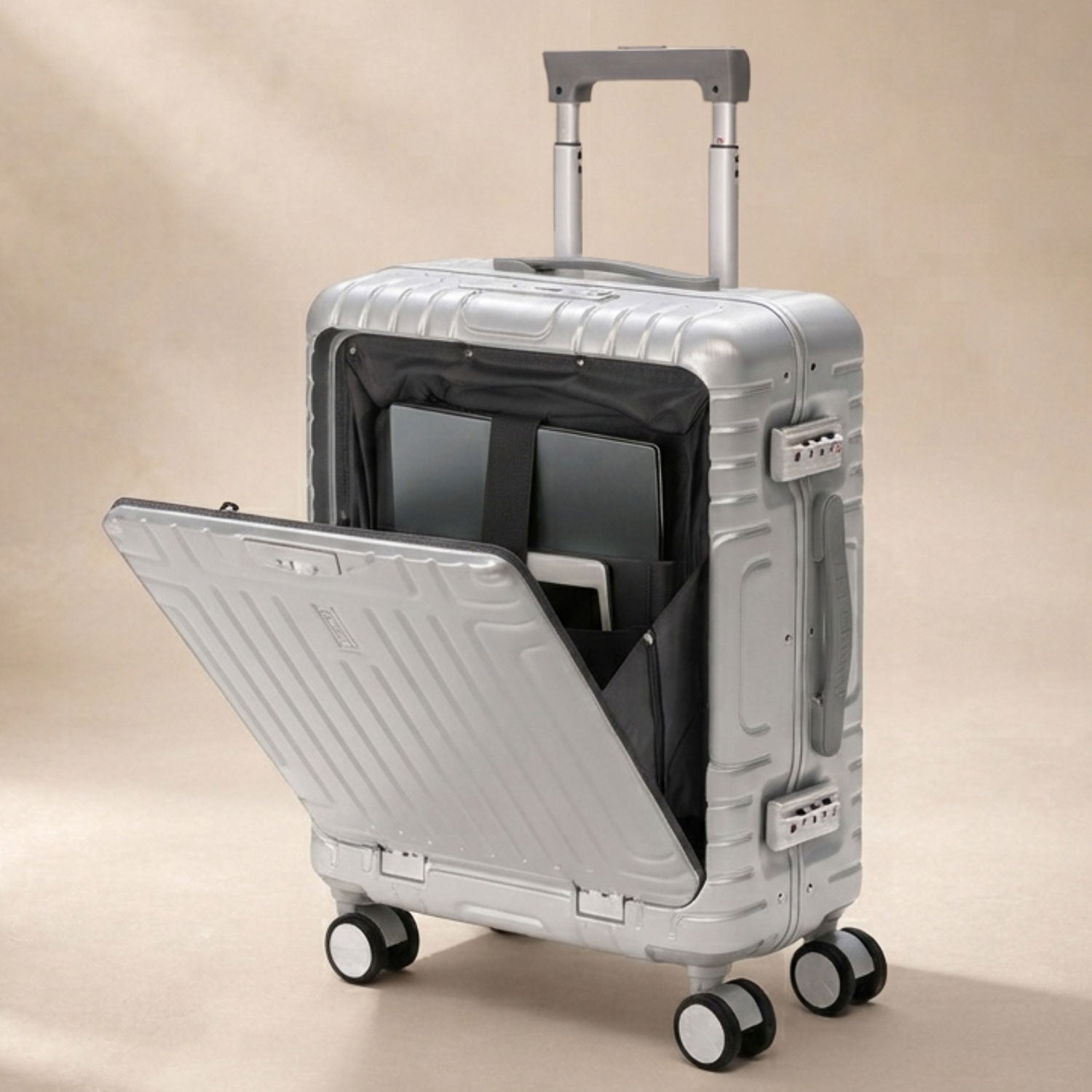
Cabin Luggage Collection
Hard shell and soft shell cabin bags from 40x20x25cm to 56x45x25cm — every one with a built-in TSA lock. Approved for Ryanair, easyJet, British Airways, Jet2, Wizz Air, and 10+ other airlines. From £24.99.
Browse Cabin Luggage →
Check-In Suitcases Collection
Medium, large, and extra-large checked suitcases — polypropylene and ABS hard shell, all with built-in TSA combination locks. Designed for every airline's checked bag allowance. From £44.99.
Browse Check-In Suitcases →The Pre-Travel Lock packlist
✈ Before Every Flight
Every Aerolite bag. Every flight. Built-in TSA lock included.
Browse cabin bags and check-in suitcases — all TSA-approved, free mainland UK delivery.
Frequently Asked Questions
Everything you need to know about TSA locks.
What is a TSA lock?
A TSA lock is a combination or latch lock on a suitcase that can be opened by airport security using a universal master key — without breaking or cutting the lock. Security opens your bag, inspects it, re-locks it, and returns it intact. TSA-approved locks carry a small red diamond symbol or the letters "TSA" on the lock body.
Do I need a TSA lock for UK flights?
TSA locks are not a legal requirement for UK domestic flights, but they are strongly recommended for any international checked luggage — particularly for US-bound flights where a non-TSA lock may be cut off by security. A built-in TSA lock means you always travel with one, at no extra cost, on every Aerolite suitcase.
How do I set the combination on a TSA lock?
Open the lock with the preset code 000, press and hold the reset button (a small recessed pin on the side), turn the dials to your chosen 3-digit code, then release the button. Your new combination is set. Test it immediately before your trip.
Is a built-in TSA lock better than a separate padlock?
Yes — a built-in lock is more secure, more convenient, and cannot be knocked off. It secures zipper pulls directly from the frame and is always present without any additional packing. All Aerolite suitcases include a built-in TSA combination lock, so you never need to buy or manage a separate lock.
Can security break a TSA lock?
If your lock is TSA-approved, security opens it with their master key and re-locks it — no damage. If your lock is not TSA-approved, security will cut it off entirely and your bag will travel the remainder of the journey unlocked. This is why TSA-approved locks are the only sensible choice for international checked luggage.
Do TSA locks work outside the USA?
Yes — TSA-approved locks are recognised and used by airport security in many countries globally, including the UK, Canada, Japan, and across Europe. A TSA lock ensures your bag can be inspected and re-secured anywhere in the world without damage to the lock mechanism.
What is a zipperless TSA latch-lock?
A zipperless TSA latch-lock replaces the zip on a suitcase with an aluminium frame and TSA-approved latch locks — similar to a briefcase clasp. These cannot be opened with a pen (a known vulnerability of zip closures) and have no zipper to wear out. Aerolite's M-Lite and full aluminium suitcases use TSA-approved latch-locks — the most secure TSA-approved closure available.